Free Ebook Extrusion Detection: Security Monitoring for Internal Intrusions
April 02, 2018Free Ebook Extrusion Detection: Security Monitoring for Internal Intrusions
Come follow us on a daily basis to understand just what publications upgraded on a daily basis. You know, the books that we offer everyday will certainly be updated. As well as now, we will offer you the new publication that can be reference. You could pick Extrusion Detection: Security Monitoring For Internal Intrusions as guide to review now. Why should be this publication? This is just one of the latest book collections to upgrade in this site. The book is likewise advised because of the strong factors that make numerous people love to use as reading material.
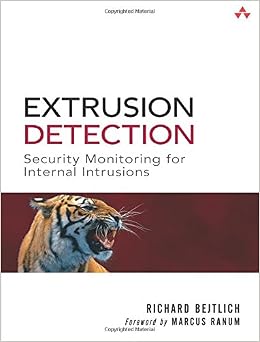
Extrusion Detection: Security Monitoring for Internal Intrusions

Free Ebook Extrusion Detection: Security Monitoring for Internal Intrusions
Don't you believe that reading publications will offer you more advantages? For all sessions as well as kinds of publications, this is taken into consideration as one way that will lead you to obtain finest. Each publication will have various statement and different diction. Is that so? What about the book entitled Extrusion Detection: Security Monitoring For Internal Intrusions Have you read about this publication? Come on; don't be so lazy to recognize more concerning a publication.
Yeah, even this is a new coming publication; it will not mean that we will certainly offer it rarely. You recognize in this instance, you could obtain guide by clicking the link. The link will certainly lead you to get the soft file of guide quickly and also straight. It will truly relieve your method to obtain DDD even you might not go anywhere. Only remain at home or office and get easy with your web connecting. This is straightforward, quick, and relied on.
It also features the top quality of the author to discuss the definition as well as words for the viewers. If you need to obtain the motivating ways just how the book will certainly be called for, you need to recognize exactly what to do. It associates with exactly how you make take care of the conditions of your requirements. Extrusion Detection: Security Monitoring For Internal Intrusions is one that will lead you to attain that point. You can totally establish the problem to earn far better.
To deal with this condition, many other people also try to get this book as their reading now. Are you interested? Pick this best book to offer today, we offer this book for you because it’s a kind of amazing book from professional and experienced author. Becoming the good friend in your lonely without giving boredom is the characteristic of Extrusion Detection: Security Monitoring For Internal Intrusions that we present in this website.
From the Back Cover
Overcome Your Fastest-Growing Security Problem: Internal, Client-Based AttacksToday's most devastating security attacks are launched from within the company, by intruders who have compromised your users' Web browsers, e-mail and chat clients, and other Internet-connected software. Hardening your network perimeter won't solve this problem. You must systematically protect client software and monitor the traffic it generates."Extrusion Detection" is a comprehensive guide to preventing, detecting, and mitigating security breaches from the inside out. Top security consultant Richard Bejtlich offers clear, easy-to-understand explanations of today's client-based threats and effective, step-by-step solutions, demonstrated against real traffic and data. You will learn how to assess threats from internal clients, instrument networks to detect anomalies in outgoing traffic, architect networks to resist internal attacks, and respond effectively when attacks occur.Bejtlich's "The Tao of Network Security Monitoring" earned acclaim as the definitive guide to overcoming external threats. Now, in "Extrusion Detection," he brings the same level of insight to defending against today's rapidly emerging internal threats. Whether you're an architect, analyst, engineer, administrator, or IT manager, you face a new generation of security risks. Get this book and protect yourself.Coverage includesArchitecting defensible networks with pervasive awareness: theory, techniques, and tools Defending against malicious sites, Internet Explorer exploitations, bots, Trojans, worms, and moreDissecting session and full-content data to reveal unauthorized activityImplementing effective Layer 3 network access controlResponding to internal attacks, including step-by-step network forensics Assessing your network's current ability to resist internal attacksSetting reasonable corporate access policiesDetailed case studies, including the discovery of internal and IRC-based bot netsAdvanced extrusion detection: from data collection to host and vulnerability enumeration About the Web Site Get book updates and network security news at Richard Bejtlich's popular blog, taosecurity.blogspot.com, and his Web site, www.bejtlich.net.
Read more
About the Author
Richard Bejtlich is founder of TaoSecurity, a company that helps clients detect, contain, and remediate intrusions using Network Security Monitoring (NSM) principles. He was formerly a principal consultant at Foundstone--performing incident response, emergency NSM, and security research and training--and created NSM operations for ManTech International Corporation and Ball Aerospace & Technologies Corporation. For three years, Bejtlich defended U.S. information assets as a captain in the Air Force Computer Emergency Response Team (AFCERT). Formally trained as an intelligence officer, he is a graduate of Harvard University and of the U.S. Air Force Academy. He has authored or coauthored several security books, including The Tao of Network Security Monitoring (Addison-Wesley, 2004).
Read more
See all Editorial Reviews
Product details
Paperback: 424 pages
Publisher: Addison-Wesley Professional (November 18, 2005)
Language: English
ISBN-10: 0321349962
ISBN-13: 978-0321349965
Product Dimensions:
6.9 x 1 x 9 inches
Shipping Weight: 1.6 pounds (View shipping rates and policies)
Average Customer Review:
4.7 out of 5 stars
13 customer reviews
Amazon Best Sellers Rank:
#1,191,242 in Books (See Top 100 in Books)
Let's hear it for another exceptionally well written book on network monitoring. Aside from a very clearand easy to understand writing style, Richard hits home with practicality and rich detail. I've becomea big fan of his writings including those on his informative blog, [taosecurity].[blogspot.com].First, the praise. New material, different from that in Tao his former book, includes a more extensive lookat taps, along with defense and mitigation ( and lots of it), querying NMS data from databases, Ra tools, handlingNMS data properly and with care, and network design and filtering. There's a lot of discussion on implementingdefensive measures with Cisco products and proxies. I was glad to see more examples of argus use and theutilization of shell redirection to grab and format what you want. With that said, other things I really appreciatethat tend to be innate of Richards books are his heavy use of foot notes and citations, recommended and furtherreadings, explanations of all command-line options and arguments, methodical case-studies, and line numberand font emphasized addendum to help the reader focus on key elements when looking at large output.Richard also makes an effort to provide new tools and material not covered elsewhere as stated in his book.I always end up making notes of new tools to check out and play with. e.g. netsed, flowgrep, dhcpdump, ntsyslog.I especially enjoy his use of FreeBSD when choosing a platform, not because I think it's a good operating system ( I do),but because tech literature on the BSDs is not as abundant as it is for other operating systems. This will attract theinterest of newer and non-users.Finally, the criticism. This is probably less of the author but I really didn't like that the page numbers in this bookwere on the inside corners ( next to the binding) rather than the outside. You have to really open the book in roomsthat are not well lit to see the page numbers. There is a formatting error on pg 52 where the 22 foot note is:"Start Squid by simply executing squid.2 2" 22 is separated by what looks to be two spaces and the leastsignificant 2 :) runs into the letter "Y" on the word "You" in the next sentence. Again, less the author and morethe editor (maybe?), there's a mistake on page 100. In the sentence, "This means we could forge any TCP packetwith content uid=0(root0) and...", I believe the sentence means uid=0(root) rather than uid=0(root0). Personalrequests: I would have liked to seen more examples of BRO, rather than snort, a case study of a web app attack,and more use of ARGUS and its Ra tools.Conclusion: This book was informative and an enjoyable to read, I highly recommend it.
You don't need to be an Analyst within the government to find value here. The book gets into understanding ports, protocols and how they work to assist in determining odd traffic on the network. Today we have tools like ArcSight with serve up a lot of data to comb thru yet their courses do not teach you how to be an analyst. This book is based on teach anyone how to become a very good analyst.I started as an Analyst in 2003 and the first real event was one trying to get out of the network. So this book, while dated, has some great tools for IA analysts out there to use everyday. It's interesting how network flow is just becoming a tool we use regularly today. Mr. Bejtlich provides alot of basic tools here for anyone to learn and then use on their network.Can't wait to attend one of his classes.
This is one of the authoritative books on Intrusion Detection and Incident Response, focusing on the insider threat. If you work in a SOC, do any kind of IDS analysis or InfoSec work, I highly recommend not only this book, but Richards entire collected work as "required reading".Remember, 80% of attacks come from the inside!Experience: 5 Years of IDS analysis & SOC leadership, 10 years of Security & SIEM Engineering
Following the success of 'The Tao of Network Security Monitoring' last year, world renowned security expert Richard Bejtlich raises once again the standard for security professionals, this time by focusing on analyzing threats coming from within our network - a kind of underestimated area.Traditionally, the point of network security is about keeping the bad guys out of a network ¡V ¡¥out¡¦ being where we hope they are to start with. Possible points of entry are considered to be devices accessible from the outside in some way, mostly servers and perhaps routers. Workstations with no address on the network have no apparent footprint that would betray their existence, so if potential intruders don't even know the hosts exist, and are unable to make any connection to them, how could they possibly exploit them? The truth is they can, in many ways, using not only technical skills but imagination and ability to exploit the human factor - against which no automated procedure or device can defend for long.Furthermore, many administrators put all their effort and resources into trying to design an impenetrable network infrastructure, but ignore the fact that every prevention measure is bound to fail at any moment. These administrators put little or no thought into the possibility of a real intrusion and, as a result, when it occurs the network infrastructure they've built doesn't allow them to cut their losses to a minimum, regain control in a timely manner and collect credible evidence that may lead to a future investigation.This, Richard Bejtlich's second book on the subject of network security, attempts to establish into readers' minds a solid grounding on how things are, while emphasizing common misconceptions of the past. By intentionally introducing concepts like 'Extrusion Detection', 'Defensible Network' and 'Pervasive Network Awareness' instead of relying on popular synonyms/counterparts, he addresses issues that have not been addressed - or given the appropriate importance - elsewhere.Extrusion Detection is an extraordinary book in the sense that it moves in parallel between theory and practice, suggesting ways of thinking or functioning and explaining how these could be implemented utilizing available software.Who should read this book?Everyone will find in this book valuable ideas never considered before. Well, of course this is a network-security book, so those that will directly benefit from it are administrators and architects of large networks - or anyone that expects to find himself in such position.What will you learn from this book?Richard Bejtlich's book will take you deeply into the following skills:- Designing defensible network infrastructures. As you will find out, a defensible network is a superset, and more accurate version, of what is referred to elsewhere as a 'secure network'. Given the fact that there can be no totally secure network, a defensible network is the best security status that can possibly be achieved through designing, monitoring, controlling and policing procedures.- Deploying Intrusion Detection/Prevention Systems in a way that will maximize their efficiency.- Following a series of technical practices to minimize the possibility of exposure of internal networks to the outside. Also dealing with the network effects of host-centric security threats like viruses, malware, trojans and worms, through traffic-control means.- Designing and following security policies that will minimize the resistance, detection and counter-reaction abilities of internal networks to any intruders.- Overcoming possible technical obstacles in order to have an appropriately monitored network, in other words achieving Pervasive Network Awareness. Available hardware and software products, as well as methods for their optimum deployment, are described in detail.- Utilizing well-established techniques, like routing and traffic filtering/control in multiple layers to increase the network's defensibility.- Capturing, analyzing, safekeeping and concentrating traffic in various levels. Making distinctions between malicious and legitimate traffic, detecting misconfiguration anomalies and taking the appropriate course of action in each circumstance.- Responding, in the event of an intrusion, in a way that will minimize the consequences and the extent of the intrusion while gathering, analyzing and preserving all possible evidence. Classifying/assessing any possible threat and making the best decisions in real-time.- Presenting evidence and conclusions derived by technical means, in a courtroom or to another, non-technical audience.Recommended skills to get the most out of this book:- Familiarity with basic networking and security concepts is required. You need to understand how TCP/IP works, how traffic filtering applies and how intruders commonly attack.- Familiarity with open source operating systems is highly recommended. Though the book is written in such a way that its concepts apply beyond specific operating systems or other software and any specific instructions serve only as examples, it is true that some of the best security-related products are only available for unix platforms, so you should know how to find your way around installing and configuring them.- Host-based security practices are not discussed, the reader is expected to know how to productively administer and secure the operating systems he deploys.- Some of the techniques discussed involve writing basic scripts to make their deployment worthwhile and/or possible. Basic understanding of programming principles and familiarity with some scripting language is highly recommended.- Extrusion detection does not differ in concept from intrusion detection. Any experience in intrusion detection techniques can easily be applied to extrusion detection and would be beneficial. Readers that are looking for a more thorough reading regarding those techniques are highly encouraged to read Richard Bejtlich's 'The TAO of Network Security Monitoring'.Conclusion: This is a must-read for all security professionals or enthusiasts, networking architects and administrators that like to know what's going on in their network. I am confident that 90% of everyone that read it will make haste to implement many of the valuable ideas suggested, right after they finish reading!
Extrusion Detection: Security Monitoring for Internal Intrusions PDF
Extrusion Detection: Security Monitoring for Internal Intrusions EPub
Extrusion Detection: Security Monitoring for Internal Intrusions Doc
Extrusion Detection: Security Monitoring for Internal Intrusions iBooks
Extrusion Detection: Security Monitoring for Internal Intrusions rtf
Extrusion Detection: Security Monitoring for Internal Intrusions Mobipocket
Extrusion Detection: Security Monitoring for Internal Intrusions Kindle
0 komentar