Download Ebook The Common Place of Law: Stories from Everyday Life (Chicago Series in Law and Society)
September 02, 2012Download Ebook The Common Place of Law: Stories from Everyday Life (Chicago Series in Law and Society)
Connected to this condition, you will certainly additionally discover May books that can be resources for your life. It is not just this sort of subject; you may likewise find others as good as this book to serve. Obviously, what we give is just what ideal in this world. So, you could not be stressed to pick The Common Place Of Law: Stories From Everyday Life (Chicago Series In Law And Society) as one of motivating analysis publication. Now, no matter what to do, you have to get this book and obtain adhering to the system to be much easier and also quicker.
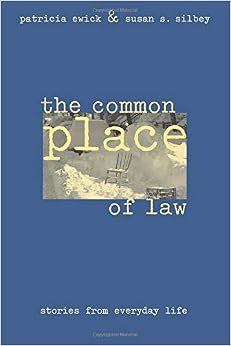
The Common Place of Law: Stories from Everyday Life (Chicago Series in Law and Society)

Download Ebook The Common Place of Law: Stories from Everyday Life (Chicago Series in Law and Society)
Book fans, when you require a brand-new book to read, locate the book The Common Place Of Law: Stories From Everyday Life (Chicago Series In Law And Society) here. Never stress not to discover what you need. Is the The Common Place Of Law: Stories From Everyday Life (Chicago Series In Law And Society) your needed book currently? That holds true; you are truly a good user. This is a perfect book The Common Place Of Law: Stories From Everyday Life (Chicago Series In Law And Society) that originates from wonderful writer to share with you. The book The Common Place Of Law: Stories From Everyday Life (Chicago Series In Law And Society) supplies the very best experience as well as lesson to take, not only take, however also learn.
Knowing several publications may not confirm you to be a better individual. Yet recognizing and also reading publications will certainly make you really feel better. Book at the device to get to effective is smart words that are uttered by some individuals. Do you think it? Maybe, just few people that like words as well as believe in those words. However, you need to think it due to the fact that book could bring you better point as meant as the goals of reading and publications. As the The Common Place Of Law: Stories From Everyday Life (Chicago Series In Law And Society) that we serve, this is not sort of rubbish book that will affect nothing.
To recognize how guide will be, it will certainly be communicated with the performance and also appearance of guide. The topic of the book that you wish to check out should be related to the topic that you need or the subject that you such as. Checking out normal book will not be interested for you even you have held in on your hands. This is one trouble to constantly fix. But right here, when obtaining The Common Place Of Law: Stories From Everyday Life (Chicago Series In Law And Society) as suggestion, you could not fret any more.
This is what you could take from this book. By soft file forms, you can be offered to review it in the gizmo when you remain in your means home in automobile or bus or even train. It is your time likewise to read it when you are remaining in a waiting listing. And exactly how you could read The Common Place Of Law: Stories From Everyday Life (Chicago Series In Law And Society) in your house can use the moment before sleeping as well as functioning.
From the Back Cover
Why do some people take a neighbor to court over a barking dog or some other nuisance while others accept the pains and losses associated with defective products or discrimination without seeking legal recourse? Patricia Ewick and Susan S. Silbey collected accounts of the law from more than four hundred people of diverse backgrounds in order to explore the different ways that people use and experience it. Their fascinating and original study identifies three narratives of law common to the stories people tell. One is based on the perception that the law is magisterial and remote. Another views the law as a game with rules that can be manipulated to one's advantage. A third describes the law as an arbitrary power that can be actively resisted. Drawing on these extensive case studies, Ewick and Silbey interweave individual experiences with an analysis that constructs a coherent and compelling theory of legality. A groundbreaking study of law and narrative, The Common Place of Law shows an institution as it is lived: strange and familiar, imperfect and ordinary, and at the center of daily life.
Read more
About the Author
Patricia Ewick is professor of sociology at Clark University and coauthor of The Common Place of Law, also published by the University of Chicago Press.
Read more
Product details
Series: Chicago Series in Law and Society
Paperback: 336 pages
Publisher: University of Chicago Press; 1 edition (July 6, 1998)
Language: English
ISBN-10: 0226227448
ISBN-13: 978-0226227443
Product Dimensions:
6 x 0.8 x 9 inches
Shipping Weight: 1.3 pounds (View shipping rates and policies)
Average Customer Review:
4.7 out of 5 stars
6 customer reviews
Amazon Best Sellers Rank:
#580,585 in Books (See Top 100 in Books)
As described, arrived on time. No issues with product or seller
Read it, got an A in my class. Would recommend.
Rapid delivery and in the condition as advertised.. Would purchase from this seller again. Flawless transaction buy with confidence here.
This book seems almost new. Great conditions. Very little highlighting. Packaged carefully on plastic bag and shipped on time. Thanks!
The Common Place of Law, by Ewick and Silbey, asserts that law exists autonomous from while being constitutive of daily life, with legality defined at one point as a social structure actively and constantly produced in what people say and do (however it must be noted that the others give other definitions of legality later in the book). Based on this conception, the authors interviewed a random sample of 430 adults in New Jersey to gain insights into their interactions, finding that people act before, with, or against the law. While this analysis brings forward interesting issues, it left many questions.First, there are basic questions regarding methodology. A random sample that only takes into account adults in New Jersey may not get a wide range of people's experiences with the law given that New Jersey has different laws, methods of judicial administration, and enforcement policies than other states. A further methodological issue concerns the fact that the interviews took 2-3 hours, eliminating those who do not have that much free time.Second, the authors left the reification issue partially unexplained. They assert that individuals construct meanings that, once institutionalized, become part of the systems that constrain future meaning making; when these ideas are constructed, how long do they take to reify, and how do they change after reification? Further, because Ewick and Silbey's theory allows for schemas to change with the introduction of new information, can reification, which by definition concerns treating something as a concrete entity, ever really occur? A schema is undoubtedly difficult to change, but it is not impossible to change, thus perhaps reification is not the proper term given the challenge at hand.Third, the idea of law being autonomous from while at the same time constitutive of everyday life is afflicted by the problem of dualism--if there is a duality between that which affects and that which is affected, then how are the two mediated? In other words, if law is both particular and general, then how is the particularity linked to the generality? Rather than a duality, perhaps the authors could argue for a unity in which all things coexist, thus each is able to influence the other.Fourth, more information on how societal schemas change over time would be helpful. If schemas can be changed by new information, how is this new information accepted, and why are some pieces of new information accepted while others are not? Using the authors' example of witchcraft, why is it that Americans by and large no longer subscribe to paganism, while in some areas it is still practiced? Some schemas must be more rigid than others, but why is this especially given the fact that the same information is available to most everyone?In summary, the authors brought forward some interesting points, but further explanation would be enlightening.
The richness of this book comes from four hundred thirty interviews that support the text. The gist of the book is that people have three takes on the law: before the law, against the law, and with the law."Before the law" is an attitude of awe and respect for the institution. Faith in that day in court, that statue of blind justice and the policeman is my friend. "Against the law" is an attitude of resistance to the institution. Law as a caprice of the powerful, and resistance the right way to deal with it. "With the law" is an attitude of game playing with the institution. I didn't make the rules, but me and my lawyer, we sure as hell will play the game. People shift and change among these modes depending on where they are in life, the particulars of the situation, and growing experience with the law.The biggest contribution of this book is in highlighting the game playing aspect of dealing with law. I think game-playing gets short shrift from other law authors who may be stuck inside their very serious institution. Most other books reduce game-playing to simple economic theory and don't pay enough attention to the human side of gaming with the law. I mean, really. Just look at how big the sports section of the Sunday paper is versus the economic analysis section! Games are a big part of everyday life. Ewick & Silbey give game-playing the appropriate type of attention. Big bravo.My only criticism is that the language of this book is mainly for an academic audience, and thus I give it only four stars-sorry. The writing could be de-academicized and made more powerful and popular. Overall it is an excellent, meticulously researched bookI got the book for its cover-the picture of chairs in newly shoveled parking space. Now that's a real hotbed of attitude in the informal/formal law divide. Thanks to the authors and worker-bees for all their work.
The Common Place of Law: Stories from Everyday Life (Chicago Series in Law and Society) PDF
The Common Place of Law: Stories from Everyday Life (Chicago Series in Law and Society) EPub
The Common Place of Law: Stories from Everyday Life (Chicago Series in Law and Society) Doc
The Common Place of Law: Stories from Everyday Life (Chicago Series in Law and Society) iBooks
The Common Place of Law: Stories from Everyday Life (Chicago Series in Law and Society) rtf
The Common Place of Law: Stories from Everyday Life (Chicago Series in Law and Society) Mobipocket
The Common Place of Law: Stories from Everyday Life (Chicago Series in Law and Society) Kindle
0 komentar