Download Ebook Paper: Paging Through History
Juni 25, 2017Download Ebook Paper: Paging Through History
Paper: Paging Through History as one of the referred books that we will certainly supply in this site has been examined to be one valid source. Also this topic prevails, the means exactly how author makes it is extremely attractive. It can draw in the people who have not understandings of reading to start reading. It will certainly make someone fond of this book to read. And it will show someone to earn far better decision.
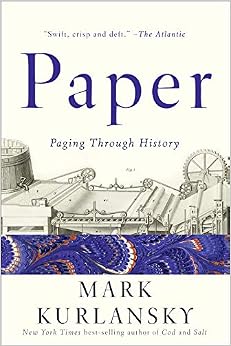
Paper: Paging Through History

Download Ebook Paper: Paging Through History
Welcome to our incredible site. This is a website that can make everyone feel so relieved. This is the one that will certainly supply all completed book collections from the publishers around the globe. Discovering the book from other countries in this sit is simple, moreover to discover guides for within the nation. That will be so simple then.
If a book from prominent writer exists, sometime several followers of them will directly purchase guide. Even any kind of book types, but are they really checking out guide? Who knows? For this reason, we will reveal you a book by familiar writer qualified Paper: Paging Through History This book will certainly give you some advantages if you actually reviewed it. The first is you could get the new words as what we have actually unknowned regarding it previously. We could additionally boost the foreign language from reading this book. There are any kind of.
When you have such certain need that you need to understand and recognize, you can begin by reviewing the lists of the floor tile. Now, we will invite you to understand more concerning Paper: Paging Through History that we additionally offer plaything you for making and getting the lessons. It includes the simple means and also simple languages that the writer has actually created. Guide is likewise presented for all individuals aspects and also areas. You may not feel tough to recognize what exactly the writer will certainly tell about.
To get guide to check out, as what your close friends do, you need to visit the web link of guide web page in this internet site. The web link will certainly demonstrate how you will obtain the Paper: Paging Through History Nevertheless, guide in soft file will be additionally simple to read each time. You could take it right into the gizmo or computer hardware. So, you could really feel so easy to conquer what telephone call as great analysis experience.
Review
“Kurlansky’s telling of this history...is swift, crisp, and deft.†- Reid Mitenbuler, The Atlantic“[An] historical journey well worth the ride. [Kurlansky] has a deep instinct for telling detail, which he combines with a disarmingly fun narrative style.†- Los Angeles Times“An historical journey well worth the ride. [Kurlansky] has a deep instinct for telling detail, which he combines with a disarmingly fun narrative style. Kurlansky makes a compelling case that paper has always been a revolutionary force – a foundation for expression of every sort ― and that it is certainly not dead yet.†- Elizabeth Taylor, The National Book Review“Kurlanksy tells [the history of paper] vividly in this compact and well-illustrated book….He has a sharp eye for curious details….[and] offers a versatile introduction to this long and complicated history.†- Anthony Grafton, New York Times Book Review“A beautiful thing to hold and feel, and it presents a fine argument for the retention of paper as an aesthetically lusty object.†- Simon Garfield, The Observer“One learns an awful lot from [Paper], all packaged in Kurlansky’s whipsmart prose.†- John Sutherland, The Times (London)“Littered with amazing facts.†- Lily Rothman, Time magazine
Read more
About the Author
Mark Kurlansky is the New York Times best-selling author of twenty-nine books and a former foreign correspondent for The International Herald Tribune, The Chicago Tribune, The Miami Herald, and The Philadelphia Inquirer. He lives in New York City.
Read more
Product details
Paperback: 416 pages
Publisher: W. W. Norton & Company; 1 edition (May 23, 2017)
Language: English
ISBN-10: 9780393353709
ISBN-13: 978-0393353709
ASIN: 0393353702
Product Dimensions:
5.5 x 1.1 x 8.3 inches
Shipping Weight: 12.8 ounces (View shipping rates and policies)
Average Customer Review:
4.0 out of 5 stars
99 customer reviews
Amazon Best Sellers Rank:
#124,441 in Books (See Top 100 in Books)
Not well researched or organized. The text goes all over the place, often leaving paper per se very far behind. Largest problem are the glaring errors which can't be ignored. Some make Gutenberg sound like some kind of simpleton. For example, on page 113, Gutenberg did not ink his type with “his own formula of gallnut shaving…soot and water,†as stated by the author. Such ink would simply pool on the metal surface of the typeface then run off, smear and soak into the handmade paper creating a blurry blot. Instead he mixed up his own ink, an ink that was definitely NOT water-based. The ink he made up had to be a special ink similar to modern day printers’ ink which is oil-based. This was an extraordinary move, a brilliant innovation, perhaps as significant as his use of movable type, hand-made linen paper and the press itself. The British Museum page on the Gutenberg Bible says: “The ink used by Gutenberg was also a new development. It was not really ink at all, more like a varnish or oil paint. Unlike writing-ink it is oil-based, not based on water. Water-based ink would simply run off the metal types whereas the thick, viscous oil-based varnish sticks to them.†His ink was also distinctive in that it had a glittering surface indicating that that it contained a high metal content, in particular copper, lead and titanium and also sulphur.Kurlansky’s statement that he used molten lead for his typeface oversimplifies the case. He used a metal alloy consisting mostly of lead and tin, with a small amount of antimony for hardening. Antimony has the rare property of expanding as it cools, giving the casting sharp edges needed to create the crisp print that distinguished his work.On page 10, Kurlansky says a papyrus reed stem used by the Egyptians to make papyrus paper “peels like an onion†– it doesn’t. The core of lightweight white pulp found inside the stem has to be sliced with a sharp knife or razor into thin slices.Further, he states there are “about twenty layers†inside the stem, again completely wrong.He needs to publish some sort of correction page to go with this book, otherwise it misinforms.
While I have loved other Mark Kurlansky books, this one comes closer to fields I have studied and I was horrified to discover that neither he nor his editors bother to fact check before publishing. I further discovered there is no way to contact the author directly to let him know of his errors.He claims that "linguists regard Greek...to be...the grandparent of all modern European languages." (page 64 of 897 ebook version) My degree from UC Berkeley in linguistics disagrees with him. Modern European languages come from a number of different language families, most NOT descended from Greek.He claims that silk contains cellulose. (page 91 of 897 ebook version). This is a gross misstatement. Cellulose is a polysaccharide: silk is a protein. These are distinctly different polymers. The idea that you can make something paper-like out of either does not make them the same thing.At that point, I had to stop reading.
I read 'Salt' and 'Cod' by MK and I enjoyed and recommend them both.But I was put off by 'Paper'.Other reviewers found many discrepancies with what they say are established facts. I wouldn't know about those things, nor would I be able to judge.I didn't enjoy the book; so much of it is just open-ended chattering about what he thinks about 'paper'. MK tells an interesting story of how paper came to be invented, developed and used in different ages across the world. Well and good; those stories are told in detail and quite worth reading.But his chatter is just that. Paper is and should be an engrossing subject, like 'Salt', or 'Cod'. Unfortunately, 'Paper' is not nearly as interesting.
I loved Kurlansky's Salt, but this book is not about the commodity paper. It's about printing and what people were thinking about at various times. It's also pervasively political: Kurlansky admires Muslims and hates Europeans. What that has to do with paper is not obvious.The author thinks that printing was invented to talk about religion and facilitate religious wars. It is a commonplace in communications theory that the opposite is true: whenever communications improve, wars start, because it turns out that what people most want to communicate about is how much they hate each other. So Gutenberg's 1450 printing press started the 200 years of war during the Reformation. It can't be the other way around because if so, printing would have been invented during the birth and spread of Christianity in the Roman Empire, 0 to 350 AD. That Twitter and Facebook were used to start all the many wars of the Arab Spring and the other revolutions such as in Ukraine is well known. But Twitter and Facebook were not invented in order to start revolutions. The Internet improved communications and was used that way, that's all.This hardback book was printed on lovely deckled paper, but the content isn't worth the paper it's printed on. I'm disappointed: I really wanted to read a book about paper, since I used to work for a large scientific printer, but this book is not about paper.
"Salt" is one of my all-time favorites, and I enjoyed Cod and Basques as well. I was overjoyed to see Kurlansky getting back into the history game with "Paper". Let me say that I enjoyed the book. Not as much as the other three, but it was enjoyable to read. There were a few questionable "facts", and I see why some reviewers have jumped on them, but none of these take away from the overall message in my mind. The only addition I'd like to make is that "less is more" would have been helpful in parts. The section of his trip to Japan really managed to weigh down the whole book and came across to me as him trying to justify a free trip to Japan, as was his sudden appearance in Basque country which was also out of place for the subject. All that being said, this book is a fun read. It is a delight to see Kurlansky back into the game, and I assure you I'll still give his next book a look.
Paper: Paging Through History PDF
Paper: Paging Through History EPub
Paper: Paging Through History Doc
Paper: Paging Through History iBooks
Paper: Paging Through History rtf
Paper: Paging Through History Mobipocket
Paper: Paging Through History Kindle
0 komentar