Download Ebook Capital Ideas: The Improbable Origins of Modern Wall Street
Agustus 10, 2014Download Ebook Capital Ideas: The Improbable Origins of Modern Wall Street
Associated with this problem, you will likewise learn May publications that can be sources for your life. It is not only this type of topic; you could likewise locate others like this publication to serve. Certainly, what we provide is just what finest in this world. So, you may not be fretted to choose Capital Ideas: The Improbable Origins Of Modern Wall Street as one of motivating analysis book. Now, no matter what to do, you have to get this publication and also obtain complying with the system to be a lot easier and also quicker.
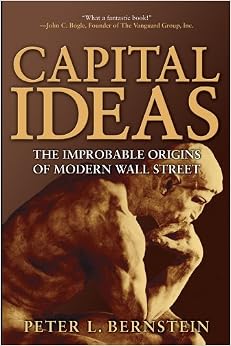
Capital Ideas: The Improbable Origins of Modern Wall Street

Download Ebook Capital Ideas: The Improbable Origins of Modern Wall Street
Have you detailed what should you obtain today? Exists any plan and suggestion to obtain the brand-new collection of book? Well, if you have not that type of strategy, we will certainly affect you as well as see to it you to take it in provided. Book is much suggested to be always in list for you. It is sort of everyday requirement. So, when you reserve much loan for other needs, you likewise have to reserve some cash to buy guide.
In this situation, Capital Ideas: The Improbable Origins Of Modern Wall Street is favored for being the most effective reading material. This publication has some factors as well as reasons you need to read it. Initially, it will certainly be about the material that is composed. This is not about the extremely stationary analysis material. This is about how this publication will influence you to have reading behavior. This is extremely interesting topic book that has actually been renowned in this current time.
Reviewing guide Capital Ideas: The Improbable Origins Of Modern Wall Street by on-line can be also done conveniently every where you are. It seems that hesitating the bus on the shelter, waiting the list for queue, or other locations possible. This Capital Ideas: The Improbable Origins Of Modern Wall Street can accompany you because time. It will not make you really feel bored. Besides, by doing this will additionally enhance your life high quality.
So, merely be below, discover guide Capital Ideas: The Improbable Origins Of Modern Wall Street now and read that swiftly. Be the first to review this book Capital Ideas: The Improbable Origins Of Modern Wall Street by downloading in the link. We have some other e-books to review in this web site. So, you can discover them also conveniently. Well, now we have actually done to provide you the very best publication to review today, this Capital Ideas: The Improbable Origins Of Modern Wall Street is actually suitable for you. Never ever ignore that you require this e-book Capital Ideas: The Improbable Origins Of Modern Wall Street to make far better life. Online e-book Capital Ideas: The Improbable Origins Of Modern Wall Street will really offer very easy of everything to check out as well as take the perks.
Review
Richard Brealey London Business School This is a great book...captures marvelously the excitement of the search for new ideas.
Read more
From the Back Cover
CAPITAL IDEAS Capital Ideas traces the origins of modern Wall Street, from the pioneering work of early scholars and the development of new theories in risk, valuation, and investment returns, to the actual implementation of these theories in the real world of investment management. Starting with the French mathema-tician Louis Bachelier—who wrote about the unpredictability of stock prices in the early 1900s—Bernstein brings to life a variety of brilliant academics who have contributed to modern investment theory over the years: Harry Markowitz, who wrote about optimizing the tradeoff between risk and reward William Sharpe, who shook the pillars of the investment establishment by asserting that the market cannot be beaten Fischer Black, Myron Scholes, and Robert Merton, who paved the way for the creation of financial derivatives and new ways of controlling risk Franco Modigliani and Merton Miller, who extolled the central role of arbitrage in determining the value of securities Filled with in-depth insights and timeless advice, Capital Ideas reveals how the unique contributions of these talented individuals profoundly changed the practice of investment management as we know it today.
Read more
See all Editorial Reviews
Product details
Paperback: 360 pages
Publisher: Wiley; 1 edition (June 20, 2005)
Language: English
ISBN-10: 0471731749
ISBN-13: 978-0471731740
Product Dimensions:
6 x 1.1 x 8.9 inches
Shipping Weight: 1.1 pounds (View shipping rates and policies)
Average Customer Review:
3.7 out of 5 stars
26 customer reviews
Amazon Best Sellers Rank:
#28,180 in Books (See Top 100 in Books)
For obvious reasons i.e. "how did we get into this mess", the origins of finance have come under scrutiny. This book provides an excellent historical perspective. It is not a heavy mathematical read, but more of a historic narrative, written from the perspective of an expert market practitioner. It leaves off in the late 1990's and therefore does not include the more recent excesses, but is a very good overview of the key developments that is well worth reading, even if you disagree with the direction finance has taken, it is useful to know how it got there.
"Poets are the unacknowledged legislators of the world....Let those who will, write the nation's laws, if I can write it's textbooks." (P. Samuelson, quoted by Berstein)Bernstein has written a fascinating pre-LTCM (pre 8/98) book on the history of econometrics and finance, beginning with the origins of the Cowles foundation as the consequence of Cowles' personal interest in the question: Are stock prices predictable? This book is all about heroes and heroic ideas, and Bernstein's heroes are Adam Smith, Batchelier, Cowles, Markowitz (and Roy), Sharpe, Arrow and Debreu, Samuelson, Fama, Tobin, Samuelson, Markowitz, Miller and Modigliani, Treynor, Samuelson, Osborne, Wells-Fargo Bank (McQuown, Vertin, Fouse and the origin of index funds), Ross, Black, Scholes, and Merton. The final heroes (see ch. 14, The Ultimate Invention) are the inventors of (synthetic) portfolio insurance (replication/synthetic options).This book consists largely of a pre-LTCM (pre-10/98) cheerleading for option-pricing mathematics based on lognormality, and corresponding synthetic portfolio insurance. Osborne and Mandelbrot are mentioned. The book is not error-free: e.g., Mandelbrot's ideas on stock prices are stated as being the origin of chaos theory (!), and Mandelbrot (of random fractals fame) is misportrayed as an `articulate proponent' of chaos theory! Another error (page 182): "..persistent forces are constantly driving the market toward (Modigliani-Miller) equilibrium." The evidence for the EMH is supposed to constitute the `proof' for this nonsense. So much for `proofs' in economics. So ingrained is the false, misleading and inapplicable notion of "equilibrium" in the minds of economists that it is hopeless to expect to educate them out of their own morass. Even Black, who was educated as a physicist as an undergrad, did no better:"When people are seeking profits, equilibrium will prevail." (F. Black, quoted by Bernstein)Among the interesting and entertaining stories that are told are: the displacement of Graham and Dodd's `value theory' by the EMH, the revolutionary role played by Wells Fargo Bank in using the `new finance math', and in creating index funds. The importance of the Miller-Modigliani `theorem, which `proved' that the (not-uniquely-defined) `value' of a corporation is independent of it's debt. Then, there is the wild-haired idea of `portfolio insurance', how to eat your cake and have it too (a free lunch, derived from the assumption that free lunches don't exist). No portfolio can be insured against extreme deviations, especially those that occurred in 10/87 and wiped out confidence in LOR (Leland-O'Brien-Rubinstein Associates). But this failure of finance theory produces no crisis for Bernstein, whose book is the history of heroes, not villains. His last chapter, which can be ignored by the reader without loss, is states his ideology: free market ueber Alles. Or: equilibrium will prevail, even without restoring forces ( I like to put it this way: there are no "springs" in the market). I did get something important from this book: the origin of America's spend-spend-spend ideology in the Modigliani-Miller `theorem'.If the optimal portfolio is not risky enough, borrow to finance it's purchase. (Wells Fargo's application of Tobin's idea, quoted by Bernstein)(This is a shorter version of a longer review that appeared in fall(...).
Capital Ideas: The Improbable Origins of Modern Wall Street by Peter Bernstein is a classic with a great historical perspective.
Its a nice book, if you want to know the story behind wall street in a very comprehensible way you need to read this book.
This is a very nice book to read. If you are studying investments this will put everything you learn together for you in the time the ideas were developed; the people, the time and the thoughts that have developed some of the market theories to today.
Really interesting, helps you understand the basics well. Very well written!
This book should be on your book shelf. I would critize the book in that although it recommends against portfolios of individual securities it does not warn the investor against professional portfolio managers.By way of example:Piscaqua Research in a study covering the period 1987-96 found that only 10 out of 145 major pension funds, or just seven percent, out performed a portfolio consisting of a simple 60%/40% mix of the S&P 500 index and the Lehman Bond index respectively.Or is it logical I ask for you to believe that you can predict which actively managed funds will out perform, or are you overconfident of your skills? If you are trying to find the great fund managers who will out perform in the future ask yourself: what am I going to do differently in terms of identifying the future winning fund managers, than did the pension plans and their advisors? And if you are not going to something different what logic is there in playing a game at which others with superior resources have consistently failed?If you a really serious in finding an investment technique that will provide you with reasonable return with less risk I suggest the following little book. This is a little book that I have written and contains the essential of how to invest. Just click on the title to find the book. How to Make Money in the Stock Market-Buy 2,500 Different Stocks-Pay no Commission
Capital Ideas: The Improbable Origins of Modern Wall Street PDF
Capital Ideas: The Improbable Origins of Modern Wall Street EPub
Capital Ideas: The Improbable Origins of Modern Wall Street Doc
Capital Ideas: The Improbable Origins of Modern Wall Street iBooks
Capital Ideas: The Improbable Origins of Modern Wall Street rtf
Capital Ideas: The Improbable Origins of Modern Wall Street Mobipocket
Capital Ideas: The Improbable Origins of Modern Wall Street Kindle
0 komentar